Coming Off Mounjaro (Tirzepatide): What to Expect, Week By Week
Summary
If you’re coming off Mounjaro, here’s the straight answer: as tirzepatide clears your system (half-life ~5 days; largely gone by ~30 days), most people notice appetite and “food noise” returning, and weight regain is common unless something replaces the drug’s biological effect. [2][3][4] In the best withdrawal evidence we have, stopping tirzepatide led to substantial regain, while continuing it maintained and augmented weight loss. [1]
This guide gives you (1) a realistic timeline, (2) what you may feel and why, and (3) a practical off-ramp plan for weeks 1–2, 3–6, and beyond. It applies to adults using tirzepatide for weight management or type 2 diabetes, but if you’re using it primarily for diabetes control, the monitoring priorities change. [2][6]
Contrarian point: the problem is often not that you “lack discipline”; it’s that you are removing a powerful appetite-and-reward lever and expecting willpower to impersonate pharmacology. If you want the general framework I use for stopping medicines safely (and avoiding rebound), see how to stop medicines safely (without rebound). Keep reading because the key section is the Week-by-week off-ramp plan and what to monitor before regain becomes obvious.
What “stopping Mounjaro” actually means
Tirzepatide has an elimination half-life of about 5 days, enabling once-weekly dosing. [2][3] Practically, that means the drug declines gradually even if you simply don’t take the next injection. Using the conventional “~5 half-lives” rule of thumb, much of the drug effect has dissipated by around 4–5 weeks, and Lilly’s own medical information states it should be gone from the body in about 30 days. [4]
Translation: many people feel “mostly fine” initially, then appetite ramps later, not because something has gone wrong, but because this is how clearance works. [2][4]
Two different reasons people are on tirzepatide
Weight management/obesity: you care most about appetite return, weight trend, waist, strength/lean mass defence. [1][8]
Type 2 diabetes: you also care about glycaemic deterioration after stopping and may need medication adjustment. NICE guidance for T2D treatment pathways explicitly discusses when to stop GLP-1 agents/tirzepatide and how targets influence continuation. [6]
What the best evidence says happens after you stop
The cleanest withdrawal evidence: SURMOUNT-4
SURMOUNT-4 is the trial people should cite more often because it tests the real question: what happens when you withdraw tirzepatide after weight loss?
In adults with obesity or overweight, those who had tirzepatide withdrawn regained a substantial amount of lost weight, while those who continued treatment maintained and augmented their weight reduction. [1]
A later analysis links greater regain with greater reversal of the cardiometabolic improvements seen during treatment (waist, blood pressure, lipids, glycaemic measures). [7] For how to interpret those numbers in real life, see interpreting your weight, waist and blood markers properly.
Big-picture reversal after stopping weight-loss drugs
A BMJ systematic review/meta-analysis (37 studies; 9,341 participants; multiple medications including GLP-1–based drugs) estimated average regain of roughly 0.4 kg per month after cessation, with cardiometabolic improvements trending back towards baseline over time. [8] You don’t need the exact number to grasp the message: if the intervention ends, physiology drifts back. [8]
Why rebound happens (beyond “your appetite returns”)
The drug was doing two jobs: reducing appetite and modulating reward-driven eating. When removed, your baseline appetite/reward signalling reasserts itself. [1][7]
Your energy expenditure may be lower after weight loss: post-weight-loss physiology is often more “efficient”, so the same intake can produce easier regain (inference consistent with long-known weight maintenance biology).
The environment didn’t change just because the injection stopped: food availability, cues, stress and sleep still push intake. The medication was buffering that.
Diabetes adds another axis: stopping can raise glucose and shift medication needs. [6]
What many articles miss
“Gone by 30 days” should not be mistaken for “easy by 30 days.” The drug may clear according to a pharmacological timetable, but appetite, behaviour, and the psychological pull around eating often do not resolve so neatly. In practice, the difficult phase is better understood as a window rather than a fixed date. The same honesty is needed around tapering: it is often spoken about confidently, but the strongest evidence is not really “taper versus stop,” it is “continue versus withdraw,” and withdrawal is associated with regain. [1] That does not prove tapering is useless, but it does mean we should be precise about what is known, what is inferred, and where the evidence remains thin. Equally, weight maintenance without attention to strength and protein adequacy can be a hollow victory. If the only thing being defended is the number on the scale, body composition may quietly worsen, which is why progressive resistance training and adequate protein matter so much.
It is also important not to collapse all users into the same category. For someone using tirzepatide as part of glycaemic control, stopping is not simply a weight-loss issue but a question of targets, monitoring, and safety. [2][6] The safety messaging itself is often too vague: people are told to “ask your doctor” without being given enough clarity on what symptoms to watch for, what changes are expected, and what should prompt urgent review. That lack of specificity matters, particularly when considering red-flag symptoms and pancreatitis risk messaging in UK drug safety updates. [9]
The off-ramp plan
The off-ramp plan begins before you stop, if you have any runway at all. The first task is to decide what success means for the next eight weeks, and in practice that means early detection and early correction rather than vague hopes that things will simply settle. Set up your monitoring in advance: a weight trend, your waist measurement, and one simple strength metric that you can repeat consistently. If you want the fuller checklist, including weight, waist, strength, and metabolic markers, see the guide on what to monitor after stopping GLP-1/GIP therapy. If you have type 2 diabetes, this stage matters even more, because you should agree a glucose plan in advance, including home readings, medication adjustments, and clear thresholds for when to get in touch. [6]
Weeks 1–2 after the last dose: “The quiet decline”
In weeks 1 to 2 after the last dose, there is often what might be called the quiet decline. You may notice very little, or only a subtle rise in appetite, and this is exactly the period in which people can become falsely reassured. The drug is still falling, not truly absent. [2][4] The minimum effective response here is not dramatic, but structured: weigh yourself three or four times a week without becoming obsessive, aim to detect trends early, anchor every meal around a clear protein source, and make two full-body resistance sessions per week the minimum floor. The goal is progressive training, not punishment. If you have diabetes, this is also the time to increase glucose monitoring temporarily if that has already been agreed. [6]
Weeks 3–6: “Appetite returns; regain risk rises”
Weeks 3 to 6 are often the real turning point, because tirzepatide exposure is now much lower and may be close to negligible by the end of this period. [2][4] This is when hunger and cravings may feel more present, food cues may become louder again, and a small upward drift in weight may begin before most people are willing to admit it. The key here is to act on trend rather than emotion. If your weight trend rises for two consecutive weeks, the answer is not to chase motivation but to tighten structure: use pre-planned breakfasts, keep fewer trigger foods at home, get protein in earlier, and reduce liquid calories. If you are unsure how to distinguish ordinary fluctuation from true upward drift, or how to interpret waist and blood markers alongside weight, that is where proper tracking becomes useful rather than excessive. At the same time, increase resistance training slightly by adding a third short session or simply adding more sets, with the aim of preserving strength. Add low-friction activity as well, such as walking after meals or anything simple enough to repeat. If you have diabetes and your readings are climbing, involve your clinician early rather than waiting for HbA1c to tell the story retrospectively. [6]
Beyond 6 weeks: “New baseline”
Beyond six weeks, you are increasingly living without the pharmacological buffer. [2][4] At this point, strength becomes the north star because it relates to function and helps defend against metabolic drift. Monitoring should become boring and permanent: a regular weight trend and a weekly waist measurement are usually enough. If regain becomes substantial, options may need to be considered, including restarting treatment or using alternative strategies, but this should be understood as a clinical decision rather than a personal failure. In the UK, NICE obesity guidance and access criteria are clear about who qualifies and under what circumstances. [5]
When to involve your clinician (not as a formality)
Your clinician should be involved not as a formality, but whenever the situation genuinely calls for it. That includes type 2 diabetes, where stopping tirzepatide is likely to affect glucose control and medication needs. [2][6] It also includes rapid regain, significant distress, binge patterns, or loss-of-control eating, where structured obesity care may be more appropriate than advice from the internet. [5] You should also involve them if you are stopping because of adverse effects, particularly persistent or severe gastrointestinal symptoms, or if peri-operative planning is relevant, since peri-operative guidance exists and differs according to risk profile. [2][10][11]
When to seek urgent help
Urgent medical help should be sought if you develop severe or persistent abdominal pain, especially if it radiates to the back and is accompanied by vomiting, because pancreatitis must be considered. UK drug safety communications continue to highlight pancreatitis reporting with GLP-1 agents. [9] Urgent assessment is also appropriate if you develop signs of dehydration from persistent vomiting or diarrhoea, or if you have diabetes and experience red flags such as very high glucose, ketone concerns, particularly when unwell, or escalating symptoms of hyperglycaemia. Your diabetes team should provide clear thresholds, but the broader principle is simple: do not treat obvious warning signs as something to just watch and wait.
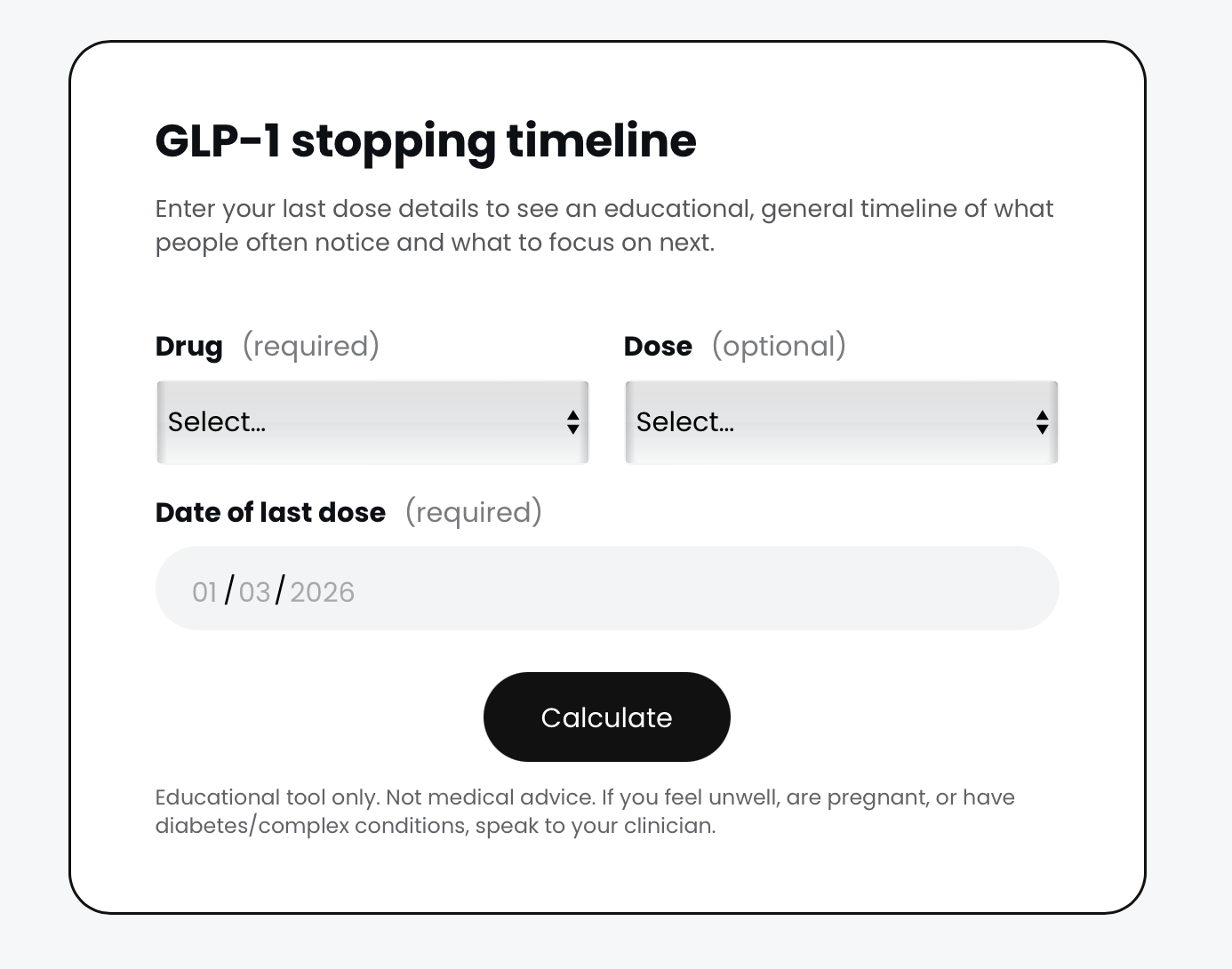
Stopping Mounjaro: GLP-1 Timeline Tool (UK) | Dr Dan Reardon
Enter your last dose date to see a general educational timeline of what people often notice after stopping Mounjaro, and what to focus on next. Not medical advice.
FAQs
-
Appetite and cravings commonly return as tirzepatide levels fall, and weight regain is frequent unless something replaces the drug’s biological effect. In withdrawal evidence, stopping led to substantial regain versus continued treatment. [1][7]
-
Tirzepatide’s half-life is about 5 days, and it’s generally expected to be gone from the body in about 30 days after the last dose. [2][3][4]
-
Many people do. In the SURMOUNT-4 withdrawal trial, those who stopped regained a substantial amount of weight compared with those who continued. [1]
-
There isn’t strong trial evidence that tapering prevents regain; the strongest evidence compares continuing vs withdrawing. Because the drug declines gradually (half-life ~5 days), “abrupt” stopping is pharmacologically less abrupt than it sounds. [1][2][3]
-
Often within weeks rather than days, consistent with the drug’s gradual clearance over ~4–5 weeks. Expect a risk window rather than a single “flip” day. [2][4][7]
-
Not in the dependence-withdrawal sense. It’s better described as loss of appetite/reward suppression plus a return to baseline signalling. [1][7]
-
Glucose can rise and medication needs can change. NICE pathways treat continuation/stopping as target- and risk-driven, so plan monitoring and follow-up rather than guessing. [6]
-
Restarting is a clinical decision and often involves dose considerations from prescribing information (particularly if a gap has occurred). Discuss this with your prescriber. [2]
-
Weight trend (not single weigh-ins), weekly waist circumference, and at least one strength marker. If you have diabetes, monitor glucose as agreed with your clinician. [6]
-
Severe persistent abdominal pain (pancreatitis concern) warrants urgent assessment; UK drug safety communications highlight pancreatitis reporting with GLP-1 medicines. [9]
Prioritised reference list
Here are some of the important references from this article. All references are available on request.
Aronne LJ, et al. Continued Treatment With Tirzepatide for Maintenance of Weight Reduction in Adults With Obesity: The SURMOUNT-4 Randomized Clinical Trial. JAMA. 2024. URL: https://jamanetwork.com/journals/jama/fullarticle/2812936. Accessed: 2026-02-26 (Europe/London).
U.S. Food and Drug Administration. MOUNJARO (tirzepatide) injection: Prescribing Information (label). 2024. URL: https://www.accessdata.fda.gov/drugsatfda_docs/label/2024/215866s010s015s022lbl.pdf. Accessed: 2026-02-26 (Europe/London).
European Commission. Mounjaro, INN-tirzepatide (SmPC annex). 2024. URL: https://ec.europa.eu/health/documents/community-register/2024/20240419162204/anx_162204_en.pdf. Accessed: 2026-02-26 (Europe/London).
Eli Lilly. How long will Mounjaro (tirzepatide) be in the body after the last dose? 2024 (review date noted on page). URL: https://medical.lilly.com/us/products/answers/how-long-will-mounjaro-tirzepatide-be-in-the-body-after-the-last-dose-165280. Accessed: 2026-02-26 (Europe/London).
National Institute for Health and Care Excellence (NICE). Tirzepatide for managing overweight and obesity (TA1026). 2024 (last reviewed 2025). URL: https://www.nice.org.uk/guidance/ta1026. Accessed: 2026-02-26 (Europe/London).
NICE. Type 2 diabetes in adults: choosing medicines (NG28 visual summary / medicines recommendations). 2026. URL: https://www.nice.org.uk/guidance/ng28/resources/visual-summary-full-version-choosing-medicines-for-firstline-and-further-treatment-pdf-10956472093. Accessed: 2026-02-26 (Europe/London).
British Heart Foundation. What happens when you stop taking Mounjaro? 2025. URL: https://www.bhf.org.uk/informationsupport/heart-matters-magazine/news/behind-the-headlines/coming-off-mounjaro. Accessed: 2026-02-26 (Europe/London).
West S, et al. Weight regain after cessation of medication for weight management: systematic review and meta-analysis. BMJ. 2026;392:bmj-2025-085304. URL: https://www.bmj.com/content/392/bmj-2025-085304. Accessed: 2026-02-26 (Europe/London).
Medicines and Healthcare products Regulatory Agency (MHRA). MHRA updates guidance for GLP-1 prescribers and patients (pancreatitis risk communication). 2026. URL: https://www.gov.uk/government/news/mhra-updates-guidance-for-glp-1-prescribers-and-patients. Accessed: 2026-02-26 (Europe/London).
El-Boghdadly K, et al. Elective peri-operative management of adults taking glucagon-like peptide-1 receptor agonists. Anaesthesia. 2025. URL: https://associationofanaesthetists-publications.onlinelibrary.wiley.com/doi/10.1111/anae.16541. Accessed: 2026-02-26 (Europe/London).
Centre for Perioperative Care (CPOC). Elective peri-operative management of adults taking GLP-1 receptor agonists (guidance document). 2025. URL: https://cpoc.org.uk/media/4751. Accessed: 2026-02-26 (Europe/London).